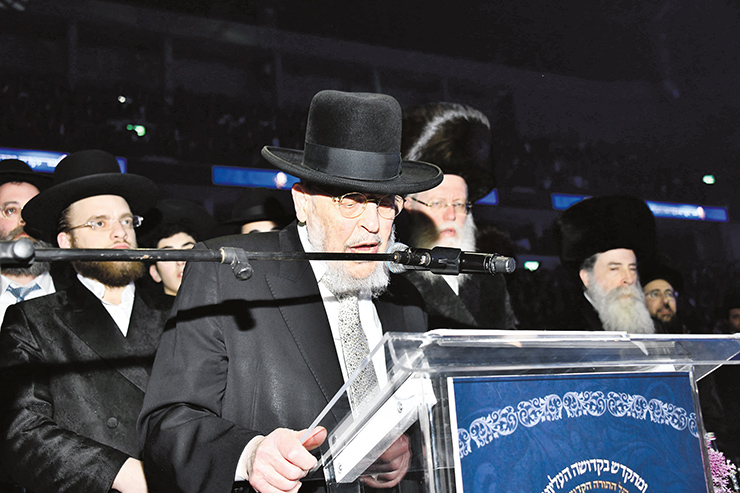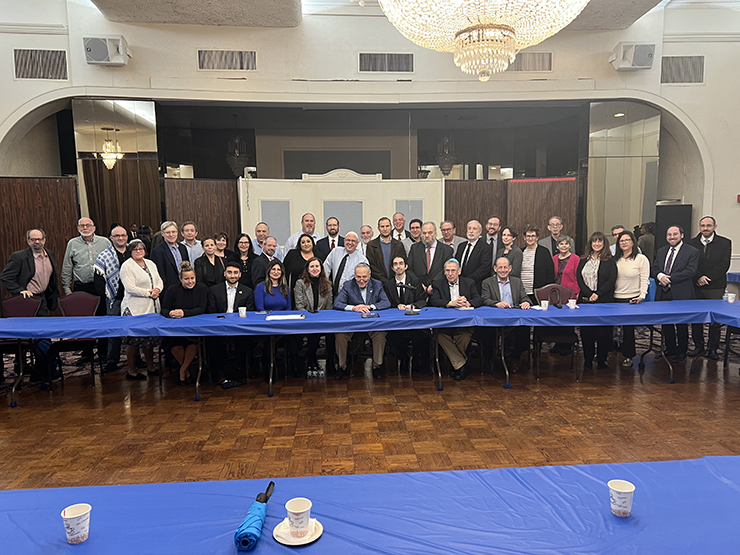

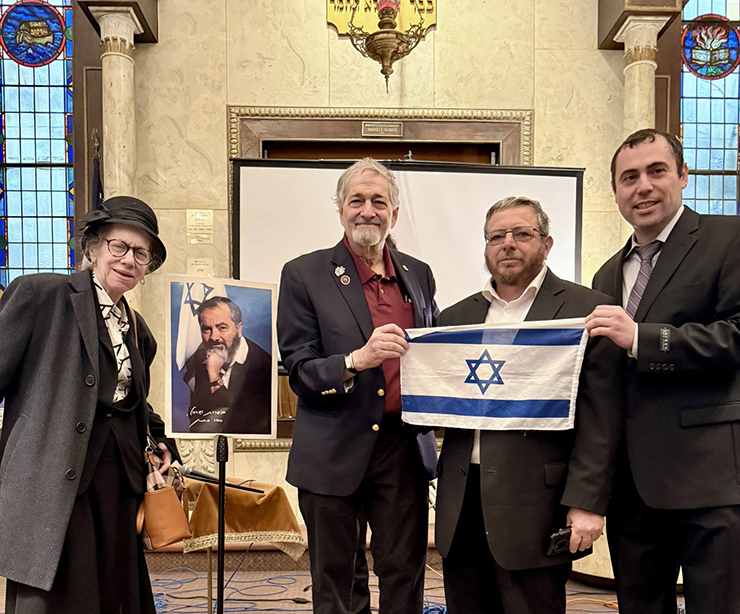
On Sunday afternoon, November 9, over 100 attendees gathered at the Ocean Avenue Jewish Center in Brooklyn to commemorate the 35th yahrzeit (18 Cheshvan) of Rabbi Meir Kahane z”l – the controversial yet enduringly influential rabbi, activist, and founder of the Jewish Defense League (JDL). Kahane, a staunch advocate for Jewish self-determination and security, was assassinated in 1990 by Egyptian national El Sayyid Nosair while speaking at the Marriott Hotel in Manhattan. His murder marked one of the first acts of Islamist terrorism on American soil, a precursor to the ideological violence that would follow in later decades.
Rather than a gathering of remembrance, the memorial emerged as a forum for reexamining the legacy of a man whose ideology continues to shape Jewish political and religious discourse. Kahane’s fierce advocacy for Jewish pride, self-reliance, and Torah-based nationalism polarized opinion during his lifetime and remains the subject of intense debate today. The commemoration took place against a charged political backdrop, as rising anti-Semitism and shifting urban politics have once again brought his warnings about Jewish vulnerability into sharp focus.
Born in Brooklyn in 1932, Kahane became one of the most provocative and formative voices in postwar Jewish life. A rabbi trained in law and international relations, he founded the JDL in 1968 as a response to anti-Semitic violence and institutional complacency in the United States. The group’s confrontational tactics – patrols in Jewish neighborhoods, public demonstrations, and campaigns for Soviet Jewry – reflected Kahane’s conviction that Jews must never depend solely on others for protection. His thought drew heavily from Revisionist Zionism and the teachings of Ze’ev Jabotinsky, merging Jewish nationalism with Torah ethics. Later, in Israel, he established the Kach movement, which called for unapologetic Jewish sovereignty and the primacy of Torah as the nation’s ethical and political foundation.
To his admirers, Kahane was a visionary who restored a sense of courage and agency to world Jewry. To his detractors, he embodied extremism, pushing the limits of democratic tolerance. Yet few would dispute his historical impact: Kahane altered how Jews conceived of collective defense, communal identity, and the moral obligations of power. Scholars and rabbis alike continue to debate whether his ideology represents a distortion or a fulfillment of Jewish political tradition.

Attorney and former JDL activist Shmuel Wilkenfeld opened the ceremony. “This is not only a memorial,” he said, “but a reaffirmation of purpose: to remember the Rav’s courage and to renew our own.” His framing cast the event not as nostalgia, but as a living continuation of Kahane’s demand for personal and communal accountability in the face of adversity. The audience – many of whom had lived through the turbulent years of 1970s Jewish activism – nodded in recognition of that shared struggle.
Bruce Balter, a veteran of the JDL’s Chaya Squad, followed with vivid recollections of Kahane’s street-level activism during New York’s tumultuous 1970s. “Rabbi Kahane wanted to change the image of the Jew,” he said. “He wanted the world to know that Jewish blood is not cheap.” Balter’s anecdotes – of volatile protests, late-night patrols, and the Rav’s unflinching composure – underscored the movement’s ethos of direct action and self-respect. “He would walk alone at night and tell us, ‘Hashem is with me – I’m never alone.’” The audience erupted in applause and chants of “Am Yisrael Chai,” echoing the militant spirit of Kahane’s early followers. His remarks demonstrated how activism and ideology intertwined in Kahane’s movement, blending theology with street politics.
Fern Sidman, former national director of the JDL and now editor of The Jewish Voice, offered a more reflective interpretation of Kahane’s mission. “We didn’t come here only to remember a man,” she said. “We came to remember a calling – to stand tall as Jews, to defend our people, and to say Hineni, Here I am.” She described Kahane as both a talmid chacham and a revolutionary, whose moral convictions were grounded in Torah yet expressed through fearless activism. Drawing from Parshas VaYeira, she likened him to Avraham Avinu, confronting moral decay with faith and moral resolve. Sidman warned of what Kahane once called the “Red-Green Alliance” – the merging of radical leftist and Islamist ideologies – which she argued has become a defining challenge of the 21st century. “He saw it all coming,” she said. “He understood that silence and compromise would erode Jewish identity from within.”
The final speaker, Yekutiel Ben-Yaakov (Mike Guzofsky), Rabbi Kahane’s former Chief of Operations and founder of the Israel Dog Unit in Samaria, grounded the discussion in contemporary reality. Wilkenfeld introduced him as “the Rav’s man in action – in Brooklyn then, in Israel now.” Guzofsky invoked Kahane’s final warning to “liquidate the exile before the exile liquidates us,” declaring, “Rabbi Kahane was right – about anti-Semitism, about aliyah, and about faith in G-d rather than faith in the nations.” He tied Kahane’s message to the events of October 7, 2023, asserting that the Hamas attacks in Israel exposed the enduring relevance of his mentor’s words. “We stand again at a crossroads in Jewish history,” Guzofsky said. “It’s time to strengthen Torah life, defend one another, and come home to Eretz Yisrael.”
The memorial concluded with Robert Schondorf leading Keil Malei Rachamim in memory of HaRav Meir Kahane z”l. Participants recited T’hilim and sang Am Yisrael Chai and HaTikvah, their voices mingling with the steady rhythm of rain outside. Many lingered afterward before a portrait of Kahane surrounded by Israeli flags and candles.
Three and a half decades after his assassination, Rabbi Meir Kahane remains one of the most polarizing figures in modern Jewish thought – a man whose warnings about moral complacency and diaspora dependence appear prescient to some and inflammatory to others. His legacy challenges both comfort and conformity: to balance idealism with vigilance, faith with realism. Whether viewed as prophet or provocateur, Kahane’s message continues to provoke reflection on the boundaries of Jewish ethics, political power, and survival in the modern age.
His words, preserved in countless speeches and writings, still echo with urgency: “No retreat from Jewish land. Faith in G-d – not in the nations. Aliyah now.”
By Shabsie Saphirstein