
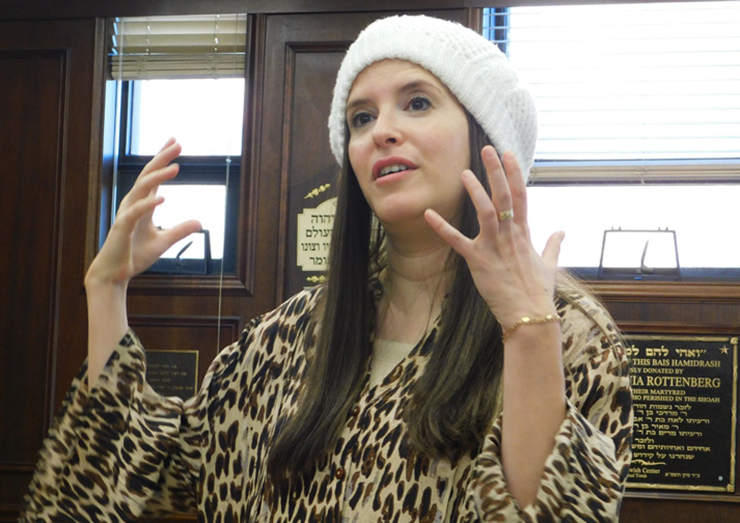
The authors of the book 40 Stories, 40 Heroes, which tells stories of ordinary people doing extraordinary things on the Gaza border on October 7, 2023, spoke to more than 50 people at the Queens Jewish Center in Forest Hills on Sunday, November 2.
Oriya Mevorach and Yair Agmon wrote the #1 bestseller in Israel. The book was released in March 2024 and is available in English.
Hamas filmed their atrocities live on October 7 to create the impression that they were winning and to encourage Hezbollah, Iran, and Palestinians in the West Bank to join in. Agmon and Mevorach did not want to watch the Hamas videos and instead chose to focus on something positive.
“We convinced them (the people in the book) that what people really need right now is a hug. It’s like a hug of hope and someone to look up to. They realized it was another way of giving,” said Mevorach. “All were humble, who said they didn’t deserve to be called a hero.”
The individuals in the stories are diverse, including non-Jews. Each story begins by introducing who the heroes were before October 7. Agmon said, “It’s full of funny stories, sweet moments, deep moments. It’s a book about love.”
One of the heroes, referred to as Mickey, did not give his last name because he is in a specialized military unit. Not even his close friends knew his role, but Hamas did; they went specifically to Kibbutz Nahal Oz to kidnap him.
Mickey, his wife, and their six-year-old hid in a safe room. His wife indicated silently that she would rather Mickey kill her, then their daughter, and then himself rather than be taken hostage. Mickey used his handgun to fight off multiple terrorists armed with explosives, RPGs, and automatic weapons. He ultimately saved his family – but Mevorach encouraged the audience to read the book for the full account.
Mickey said, “There is no despair in the world…there’s no giving up.” Mevorach added, “Giving in to despair is a moment of arrogance, because we think we know what the future will be.”
Lt. Col. Or Ben-Yehuda, the first woman to command an infantry battalion in the IDF’s Border Defense Corps, was on the Egyptian border when she received a call from her friend, Yonatan Zur, a Nahal Battalion commander, that 30 Israeli soldiers had been overrun at the Sufa Outpost.
Ben-Yehuda took 12 18-year-old soldiers to the outpost. A wounded soldier told her that 30 Israeli soldiers were barricaded in the dining hall while terrorists fired grenades and gunfire.
From behind an embankment, Ben-Yehuda saw five pickup trucks and “packs of motorcyclists and terrorists.” She recalled: “There are hundreds, and in the distance were long lines of people from Gaza just marching in our direction.”
She told herself, “If this is the end, I’ll die standing tall. I’ll do the very best I can, and fight until my last drop of blood.” She turned to her soldiers and said, “Let’s go. Let’s take them apart.”
Firing heavy machine guns, they held back waves of attackers. With one anti-tank missile remaining, they launched it at a Hamas truck, which exploded – likely because it was filled with explosives – also disabling nearby motorcycle units. The terrorists retreated, and the 30 soldiers in the dining room escaped safely.
The retreating terrorists left behind weapons and maps of additional communities they intended to attack, including Netivot (population 52,877), which was spared.
Ofek Livni used his Hyundai Tucson to rescue nine people from the Nova Festival while speaking by phone with his father, who guided him through escape routes. Agmon described it as “a story about the love of a father and a son.”
Another story featured Camille Jesalva, a 31-year-old Filipino caregiver in Kibbutz Nirim, who protected 95-year-old Nitza Hefetz during the attack. When terrorists entered their home, Camille calmly begged for their lives and surrendered their money and belongings but asked to keep her passport and plane ticket home. The terrorists spared them.
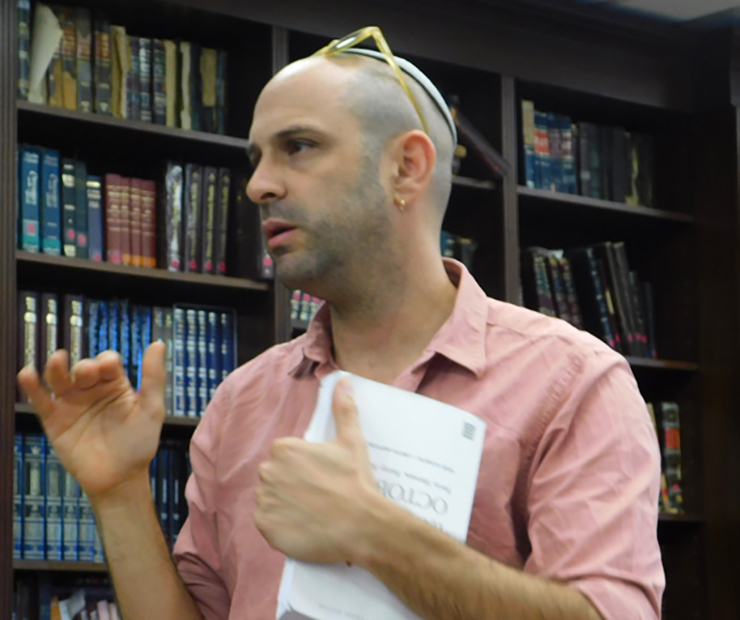
Rabbi Judah Kerbel recently returned from Israel and visited the section of Mt. Herzl where victims of October 7 are buried. One grave was especially meaningful – the grave of Amichai Vanino, after whom Rabbi Kerbel named his son. “The bonds between us here in Chutz LaAretz and Eretz Yisrael are very strong,” he said.
Agmon remarked, “We are shocked to see how involved the communities are. Every synagogue, every community. They know everything about Israel. We don’t understand in Israel how deep the connection is.”
He referenced philosopher Jacques Lacan’s teaching that trauma is pain too overwhelming to narrate, while tragedy is pain that can be expressed in story.
40 Stories, 40 Heroes has sold nearly 100,000 copies. Each interview took three to four hours and was later edited.
Rabbi Kerbel led the recitation of T’hilim 20 and prayers for Israel and the IDF, and thanked Rabbi Elisha Friedman and members of the Young Israel of Forest Hills for joining.
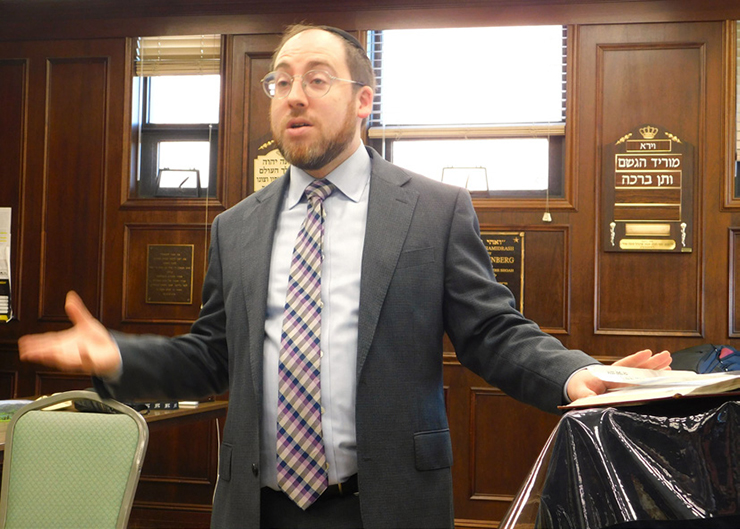
The Queens Jewish Center was the final stop on Mevorach and Agmon’s two-week US tour.
Mevorach is Chief Editor at Maggid Books (Koren Publishing) and has taught at Midreshet Lindenbaum and Herzog College. She lives in Alon Shvut, Gush Etzion.
Agmon has published seven books, four documentary films, two documentary series (including eight seasons of The Hitchhikers), and writes a weekly column for Makor Rishon. He lives in Tel Aviv.