Yael* was a 32-year-old woman who started experiencing “stomach issues” after the birth of the second of her four children. Although she had always had somewhat of a sensitive stomach as a teen (“I would pay the price if I would eat pizza, fries, and ice cream at once like my friends all seemed to be able to do”), her symptoms did not interfere with her life too much until that point. After the birth of her second baby, her symptoms of diarrhea with occasional constipation, post-meal bloating and burping, and frequent heartburn and stomach pain exacerbated to the point of severely interfering with her quality of life.

Numerous times weekly, I am contacted by individuals wanting to work with me for weight loss, but who suspect that they first need to treat an underlying digestive issue prior to starting another unsuccessful weight loss attempt. They are convinced, and I believe rightfully so, that their inability to lose weight despite tremendous efforts is stemming from unresolved gut issues. It is quite validating to them when I agree that their hypothesis has validity, as I often see that my weight loss clients with concurrent unresolved digestive issues often do not lose weight until we spend 3 to 4 months fixing up the gut. To quote Dr. Kenneth Brown:

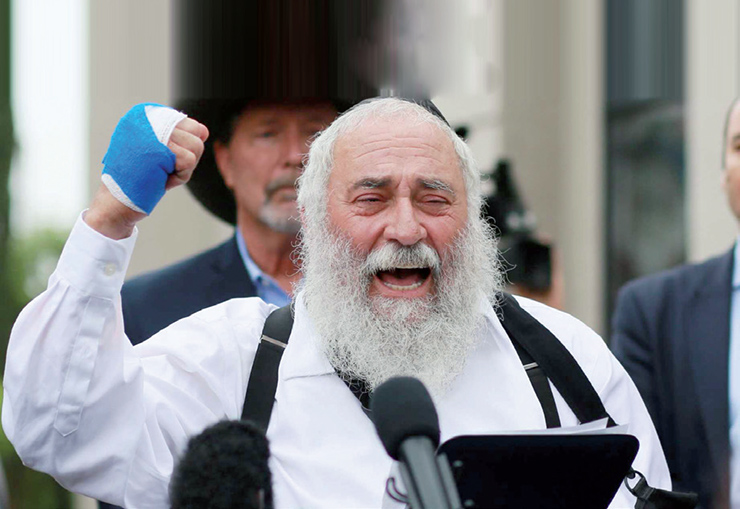
A half year after the Shabbos massacre in Pittsburgh, another white supremacist sought to do the same at the Chabad of Poway, charging into the shul as its congregants were reciting Yizkor on the final morning of Pesach. “I was preparing for my sermon, I walked out of the sanctuary and into the lobby, and I saw my dear friend Lori Kaye,” said Rabbi Yisroel Goldstein at a press conference on Sunday. “I walked into the banquet hall to wash my hands, walked two or three footsteps, and I heard a loud bang.”

A hallmark of the Jewish experience is the myriad of berachos (blessings) intertwined into the fabric of daily living. From the moment we wake up (Al netilas yadayim) until the moment we fall asleep (Hamapil), we recite berachah after berachah on every imaginable aspect of our lives — before and after eating, throughout davening, even after going to the bathroom. Every milestone of life is accompanied by a unique berachah as well: from the birth of a child, followed by bris milah and pidyon ha’ben, and subsequently to mark marriage and even death. Life’s milestones are marked and elevated through berachos.

Lomdei Daf HaYomi B’Halacha to Complete Hilchos Shabbos and Embark in Hilchos Eruvin

This coming 17 Kislev/December 7, will NOT be “A Day of Infamy.” Unlike December 7, 1941, which was described by President Roosevelt after the Japanese attack on an American base in Pearl Harbor as “A Day of Infamy.” This year, December 7th, will be a day that will live on in fame! It is the day when tens of thousands of Daf HaYomi B’Halacha learners will make a siyum on Hilchos Shabbos, Chelek Gimmel of Mishnah Berurah, in the third machzor of Daf HaYomi B’Halacha, and begin Chelek Daled!

In our previous article, we began exploring the nature of chukim and the potential limitations of reason and logic. To review, we framed our discussion with the famous line of the Vilna Gaon: “Where logic and human intellect ends, Jewish wisdom begins.” This implies that Judaism does not reject reason and logic, but builds upon it. We therefore began our discussion by exploring the purpose and utility of our intellect, and how it can help one ascertain logical proofs of spiritual truths, such as Hashem’s existence.