Remember the Occupy movement? You, know, that 2011 protest wherein a group of people held a sit-in for a number of days to remind the world that people who earn less than $500,000 a year existed? Or what about Black Lives Matter? That was pretty popular for a couple of years. March For Our Lives? The protest against the gun lobby? Or what about the Tea Party? Remember that movement of Conservatives and Libertarians to fight for a smaller federal government and a reduction of the national debt? What ever happened to these movements? You hardly hear about them anymore. Well, the truth is that they all faded over time. That’s what happens with fads. You are able to catch lightning in a bottle, exploit it for a time, and eventually the novelty fades. The truth is that all of these “movements” still exist. They have founders, heads, and websites, and still are involved in activism - albeit not necessarily the activism with which they started. But by and large, these movements go by the way of the fidget spinner – the interest decreases over time.
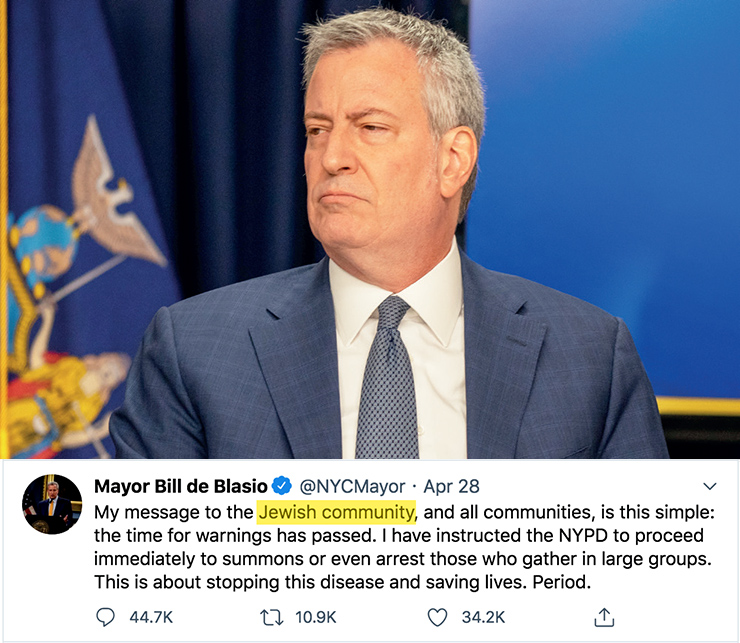
Dolt de Blasio has never cared about the city’s Jews. Now he’s scapegoating us.

 Well, it’s happened. Who would have guessed that appointing his unqualified wife to head an inane COVID relief taskforce wouldn’t be the worst thing he did that day? Just when you thought Bill de Blasio couldn’t be any worse of a mayor, he goes out and says something so egregious that he got hammered by almost everyone, ally and foe alike. On April 28, de Blasio tweeted, “My message to the Jewish community, and all communities is simple: the time for warnings has passed. I have instructed the NYPD to proceed immediately to summons or even arrest those who gather in large groups. This is about stopping this disease and saving lives. Period.”

At the time of writing, President Trump’s third State of the Union address is scheduled for Tuesday, February 4, but like last year, whether or not it takes place is up in the air. There hasn’t been an invitation extended yet, and many are calling for it to be canceled amid the impeachment hearings. Despite this, the scheduled SOU address brings us to the end of Year Three of the Trump administration. So, as last year, it is now time once again to go through the Trump administration and rate all of the major aspects of the presidency of the last year. In case you missed it the last time, we will be giving the good bits an UP and the bad bits a DOWN. And, of course, these are qualitative measures, not quantitative, so the totals aren’t the important part. This list only considers events and policies that took place after February 5, 2019.

Fight for freedom, stand with Hong Kong.” With these words, Houston Rockets General Manager Daryl Morey began the biggest international economic catastrophe an American sports league has ever faced. According to some estimates, this now-deleted tweet has the potential to cost the NBA $1 billion in Chinese revenue. And the fun only starts there.

Individual biases exist. I have them. You have them. Even scientists conducting fact-based experiments have them. The old thinking in behavioral economics was that people tended to analyze data, and based on their analysis they make their decisions. However, more recent studies suggest that this is not the case. Political economist at Stanford University Francis Fukuyama explains that people tend to “start out with an emotional commitment to a certain idea, and then they use their formidable cognitive powers to organize facts to support what they want to believe anyhow. So the partisan affiliation comes first, and the reasoning process by which you justify it comes second.” In other words, people believe what they want to believe, and when faced with facts, they either accept them as proving their beliefs, try to make them fit their world view, or discard them as inaccurate.

Because of the big election news here in New York this year, you would not be blamed for missing out on the major news out of Baltimore this past Election Day, which could be quite embarrassing for the Jewish community. Without going into too much detail, it seems there were two candidates for the Baltimore City Council: one a Jewish candidate and one the incumbent, who was not Jewish. The source of the rift was that the Jewish candidate was apparently not sufficiently pro-Israel, a stance that tends not to matter in local politics. However, it seems that this divide caused a rift in the Jewish community, which made up about 20% of the electorate, and ended up swinging the election for the incumbent, who tapped into the pro-Israel side and got enough of the Jewish vote to keep him in office.